
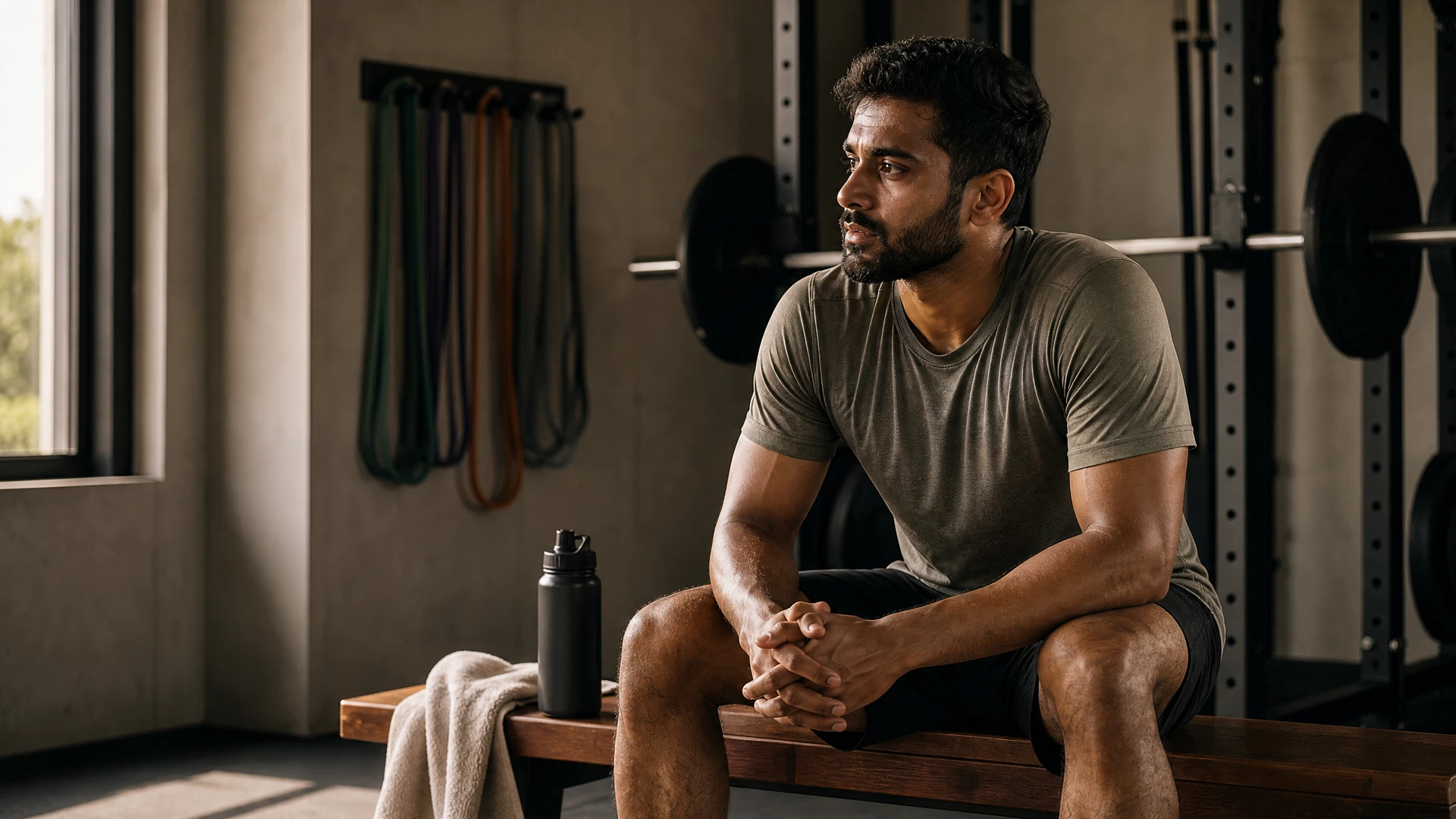
A recovery method can make you feel less sore without repairing tissue faster, restoring performance, or improving long-term adaptation. Start by deciding which outcome you actually need.
Recovery is not one outcome
Soreness, muscle damage, force production, readiness for the next session, and long-term training adaptation are related but distinct. A 2026 evidence synthesis highlighted how marketing often collapses those endpoints into one promise.[1] A useful recovery decision therefore begins with the next demand: ordinary training tomorrow, competition later today, or a long-term muscle-building programme.
| Goal | Useful question | Common mistake |
|---|---|---|
| Feel less sore | Does the method change perceived soreness? | Assuming less soreness means faster repair |
| Restore performance | Does strength, power, or endurance return sooner? | Using a biomarker as proof of performance |
| Support adaptation | Does repeated use help or hinder training gains? | Treating an acute benefit as a long-term benefit |
| Return after injury | Has the problem been assessed appropriately? | Treating normal DOMS and injury as the same thing |
Begin with sleep, food, hydration, and training load
Recovery starts with enough time between demanding sessions, sufficient food and fluid, and sleep that supports physical and cognitive function. Athlete-sleep research describes travel, training schedules, stress, and competition as common disruptors, while sports-nutrition guidance treats adequate daily protein and energy intake as foundations rather than rescue tactics.[4] [5] These basics are not a guarantee against soreness, and individual needs vary.
Cold water is a trade-off, not a universal upgrade
Cold-water immersion may help some short-term recovery outcomes and perceived soreness, but repeated use immediately after resistance training may modestly attenuate muscle growth. A 2024 systematic review included eight interventions, mostly in young men, and rated the comparative evidence as generally fair to poor.[2] Occasional use, different timing, endurance settings, and immediate competition demands are not interchangeable with repeated post-lifting use.
Stretch for flexibility, not as a soreness cure
Post-exercise stretching can still be useful when flexibility or range of motion is the goal. It has not shown a meaningful advantage over passive recovery for restoring strength or reducing delayed-onset muscle soreness. A systematic review found very low-certainty, heterogeneous evidence from 10 meta-analysed randomized trials involving 229 participants.[3]
Devices and supplements need outcome-specific proof
Electrical stimulation, oxygen-based treatments, compression products, juices, and supplements are often discussed under the single label of recovery. Evidence may apply to a narrow population, protocol, or endpoint rather than to everyone who exercises.[1] Check whether the study measured soreness, force, performance, injury, or adaptation; whether the comparison was passive rest; and whether the tested dose or device matches the product being sold.
Choose a recovery method for a defined problem. Do not let a lower soreness score stand in for every outcome that matters.
A 4 September synthesis by University of Bath researchers reinforces why the endpoint matters: a method may reduce perceived soreness without restoring muscle function, and an acute recovery effect can differ from a long-term training adaptation. It also found little support for BCAA supplements when a person already consumes adequate protein.[6] This is an academic service article drawing on reviews and trials, not a new primary experiment, and its conclusion should not be turned into a universal supplement rule.
A practical decision rule
| Situation | Reasonable starting point |
|---|---|
| Normal fatigue after routine training | Sleep, regular meals, hydration, and an appropriate next session |
| Competition or another hard effort soon | Prioritize strategies supported for short-term performance in your sport |
| Muscle-building block | Avoid making immediate cold-water immersion an automatic post-lifting habit |
| Persistent pain, weakness, swelling, or declining function | Stop self-treating and seek qualified assessment |
This article is general education, not injury diagnosis or rehabilitation advice. Severe pain, major swelling, loss of function, dark urine, chest symptoms, fainting, or symptoms that persist or worsen deserve appropriate medical assessment.
Continue with the Wellness archive or browse all Fiteforms articles.
Sources and further reading
1. National Geographic, Most Post-Workout Recovery Hacks Don’t Work. Here’s What Does. — Evidence synthesis published 3 September 2026; not a new randomized trial.
2. Piñero et al., Throwing cold water on muscle growth — 2024 systematic review and meta-analysis; eight interventions and generally fair-to-poor comparative evidence.
3. Afonso et al., Effectiveness of post-exercise stretching — Systematic review and meta-analysis of randomized trials; certainty was very low.
4. Walsh et al., Sleep and the athlete — Review and expert recommendations on athlete sleep.
5. International Society of Sports Nutrition position stand: protein and exercise — Sports-nutrition position stand; individualized needs and clinical conditions can differ.
6. The Conversation, The workout recovery techniques backed by science—and the ones that are just hype — Academic service synthesis by University of Bath researchers, published 4 September 2026; not a new primary trial.