
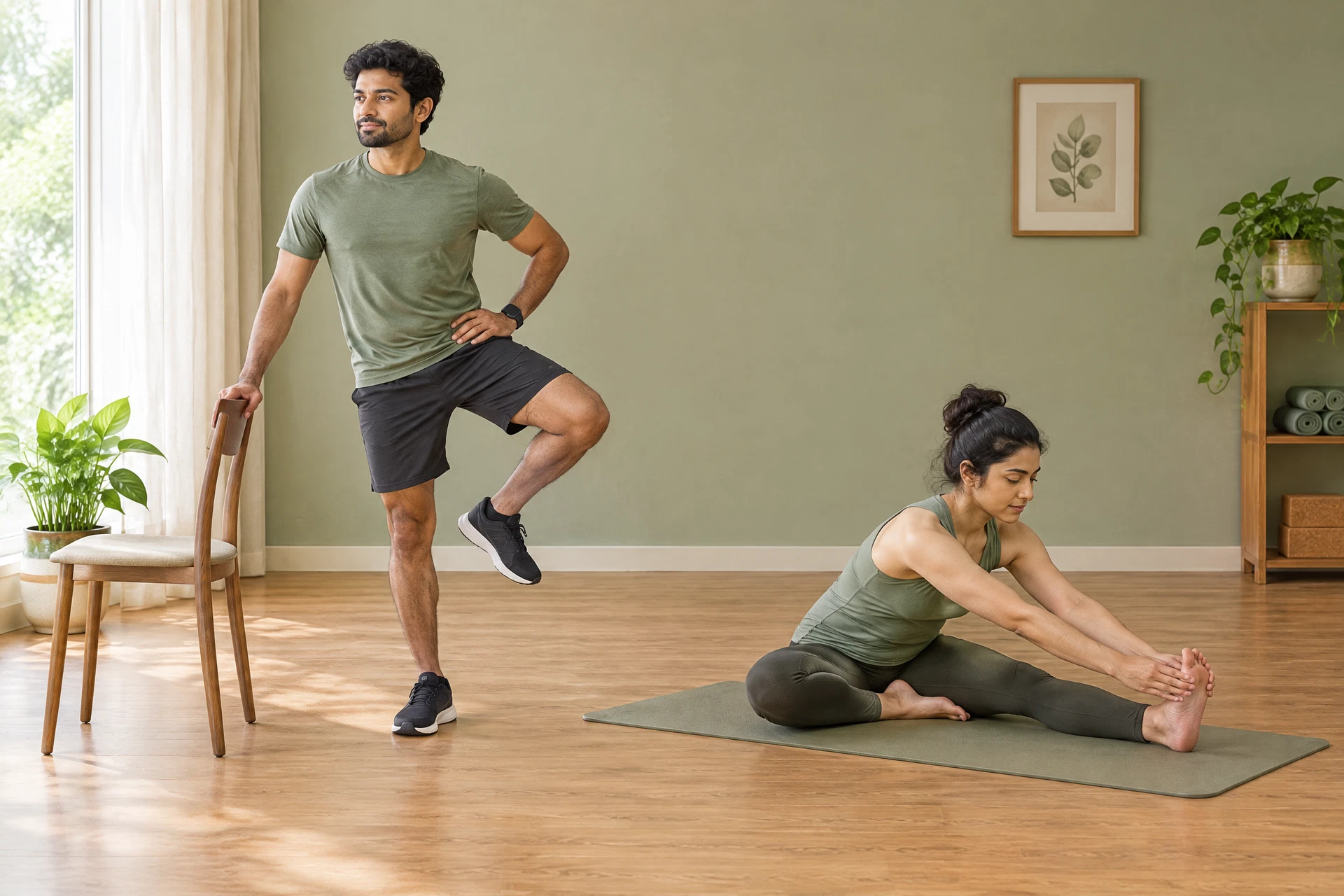
Flexibility is usually about available length or passive range. Mobility is the ability to use and control a range for a task. The terms overlap, but the training decision becomes clearer when you name the movement you need.
The practical difference
| Question | Flexibility | Mobility |
|---|---|---|
| Main idea | Available tissue length or passive range | Active, controlled movement through a useful range |
| Common test | A position reached with gravity, a partner, or an external support | A position reached and controlled by the person |
| Training example | Static hamstring stretch | Controlled hip rotation or squat with support |
| Useful for | Expanding tolerance or passive range | Applying range to a task with coordination and strength |
These are working definitions, not diagnoses. Joint structure, nervous-system tolerance, muscle capacity, technique, pain, previous injury, and the test itself can all affect the range someone displays.
Stretching is one tool, not the whole plan
Static, dynamic, and proprioceptive neuromuscular facilitation stretching can increase range of motion. A 2021 systematic review and meta-analysis compared supervised strength training with stretching across 11 randomized trials and 452 participants. It found no statistically significant difference between the two approaches for range-of-motion gains, but the programmes and populations were highly heterogeneous.[1]
Strength through range can also improve range
Strength exercises performed through a comfortable, progressively controlled range can build capacity at the same time as range of motion. This does not mean every strength exercise replaces stretching or that loaded movement is appropriate for every painful joint. It means flexibility training and strength training are not always opposites.
Choose the method by the task
| Goal | Reasonable starting method |
|---|---|
| Relax into a larger passive position | Gentle sustained stretch |
| Prepare for a fast sport movement | Progressive warm-up and task-relevant dynamic range |
| Control a deeper squat | Supported squat practice plus strength through a tolerable range |
| Reach overhead comfortably | Assess trunk, shoulder, and task setup; combine range and control work |
| Restore motion after injury or surgery | Individual rehabilitation guidance rather than a generic routine |
A short mobility sequence
Begin with easy general movement. Choose two or three joints relevant to the session. Use controlled repetitions that stay short of sharp pain. Follow with the actual exercise at a lower load or smaller range. Recheck whether the target movement feels easier; if nothing changes, more aggressive stretching is not automatically the answer.
More range is not always better
A gymnast, swimmer, weightlifter, office worker, and person recovering from injury need different ranges and different control. Excessive stretching can irritate some conditions, while instability may require capacity rather than more passive range. The goal is useful movement, not winning a flexibility test.
When stiffness needs assessment
Seek qualified assessment for sudden loss of motion, swelling, locking, instability, numbness, weakness, trauma, fever, or pain that persists or worsens. Morning stiffness with other systemic symptoms may also need medical review. A generic mobility drill cannot identify the cause.
Do not ask only, ‘Can I reach the position?’ Ask, ‘Can I use and control the range the task requires?’
This page is educational and does not diagnose joint, nerve, connective-tissue, or pain conditions. Use comfortable range and individual clinical guidance where needed.
Continue with the Mobility archive or browse all Fiteforms articles.
Sources and further reading
1. Afonso et al., Strength Training versus Stretching for Improving Range of Motion — 2021 systematic review and meta-analysis of 11 randomized trials with 452 participants. Programmes and populations were heterogeneous.
2. Currier et al., ACSM Position Stand: Resistance Training Prescription for Healthy Adults — 2026 overview of 137 systematic reviews involving more than 30,000 participants. Most underlying evidence concerns healthy adults and many studies include novice trainees.