
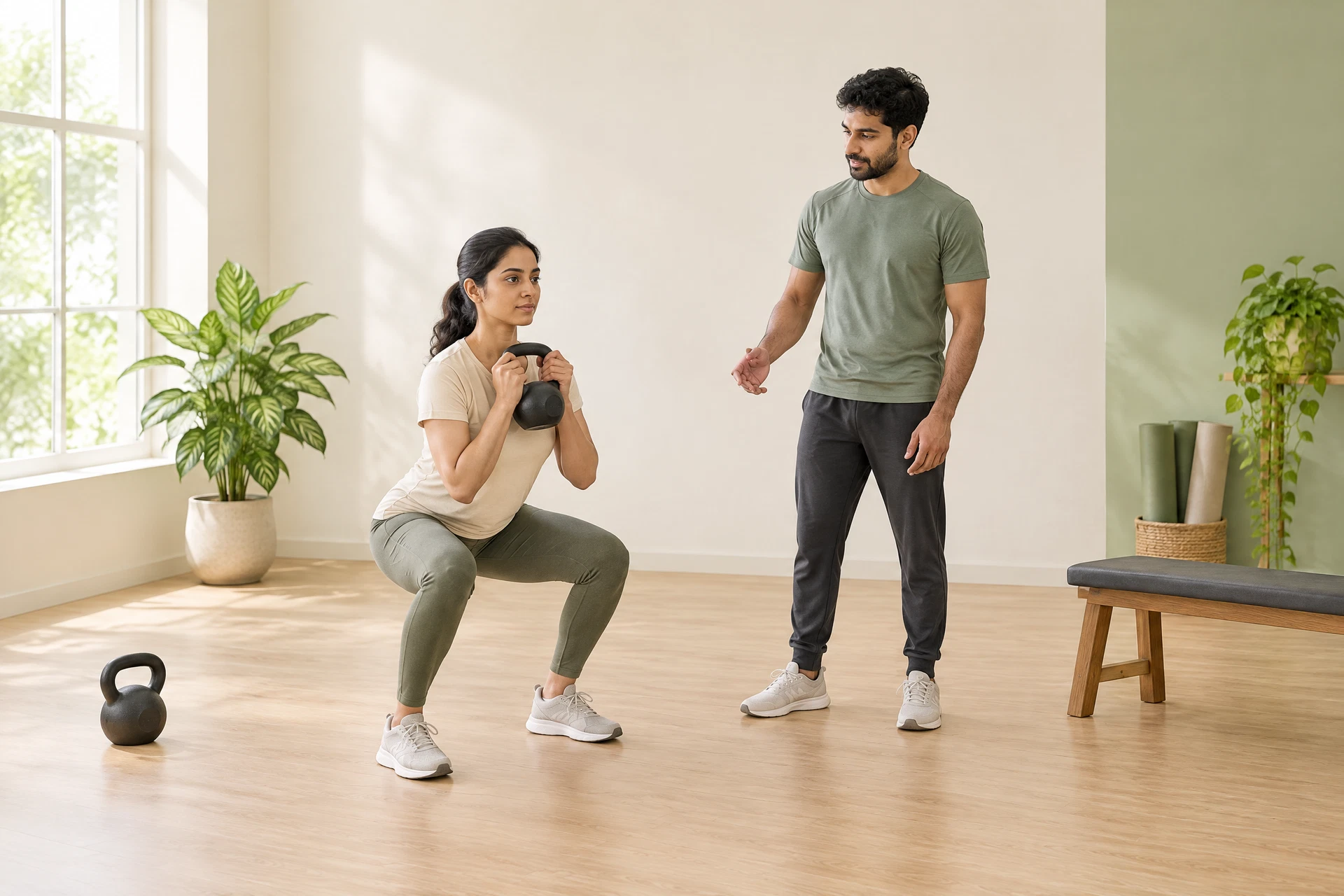
Compound exercises involve more than one joint and usually several muscle groups. They can make a programme efficient, but they are tools—not a test of seriousness, coordination, or worth.
What counts as a compound exercise?
A squat combines movement at the hips, knees, and ankles. A push-up combines shoulder and elbow actions while the trunk stabilizes. Rows, presses, step-ups, deadlift variations, and loaded carries also use several regions together. The label describes the movement, not whether it is automatically safer, harder, or superior.
| Pattern | Example | Easier or different option |
|---|---|---|
| Squat | Goblet squat | Sit-to-stand from a higher bench |
| Hinge | Dumbbell Romanian deadlift | Hip hinge to a wall |
| Push | Push-up | Wall or elevated push-up |
| Pull | One-arm dumbbell row | Resistance-band row |
| Single-leg | Step-up | Supported split squat or lower step |
| Carry | Farmer carry | One light weight or shorter distance |
Why programmes use compound exercises
They can train several muscles in one exercise, develop coordination specific to the task, and make full-body sessions time-efficient. The 2026 ACSM position stand found that resistance training improves strength, muscle size, power, endurance, and aspects of physical function compared with no training. It also reported that exercise complexity and equipment type did not consistently determine outcomes.[1]
A beginner does not need the most technical version
Choose a variation you can repeat with a comfortable range and stable setup. A machine press can be appropriate even though a free-weight press may involve more stabilization. A supported split squat can be useful even when a barbell squat appears more ‘compound’. The programme should fit the person, not force the person to fit a famous lift.
How to build a simple session
| Step | Movement | Starting approach |
|---|---|---|
| 1 | Squat or step-up | 1–3 controlled sets |
| 2 | Push | Choose an incline or load that keeps technique consistent |
| 3 | Hinge | Use a short comfortable range before adding load |
| 4 | Pull | Pause briefly without shrugging or jerking |
| 5 | Carry or trunk exercise | Short, controlled effort with normal breathing |
The number of sets and repetitions depends on the goal, training age, equipment, and recovery. The ACSM review supports progressive resistance training but also shows that many prescription details have modest or inconsistent effects. Moving from no resistance training to a manageable programme is often the more important step.[1]
Progress without chasing fatigue
When all planned repetitions are controlled and recovery is good, progress one variable: a little more load, one or two repetitions, an extra set, a larger comfortable range, or a harder variation. Training to momentary muscle fatigue did not consistently improve outcomes in the ACSM evidence overview.[1] Persistent joint pain or degrading technique is not productive overload.
Common mistakes
Too much load, rushed repetitions, copying an advanced range, changing every exercise at once, and treating soreness as proof can all make progress harder to interpret. Video can show gross movement, but it cannot diagnose pain or establish the one perfect technique for every body.
A compound exercise is useful when it helps train the intended pattern safely and repeatedly—not because it looks complicated.
This guide is not injury rehabilitation or an individual prescription. Seek qualified help for persistent pain, recent surgery, neurological symptoms, significant balance problems, or a condition affected by exertion.
Continue with the Strength archive or browse all Fiteforms articles.
Sources and further reading
1. Currier et al., ACSM Position Stand: Resistance Training Prescription for Healthy Adults — 2026 overview of 137 systematic reviews involving more than 30,000 participants. Most underlying evidence concerns healthy adults and many studies include novice trainees.
2. World Health Organization, Guidelines on physical activity and sedentary behaviour — 2020 global public-health guidance covering aerobic activity, muscle strengthening, sedentary behaviour, and population-specific considerations.