
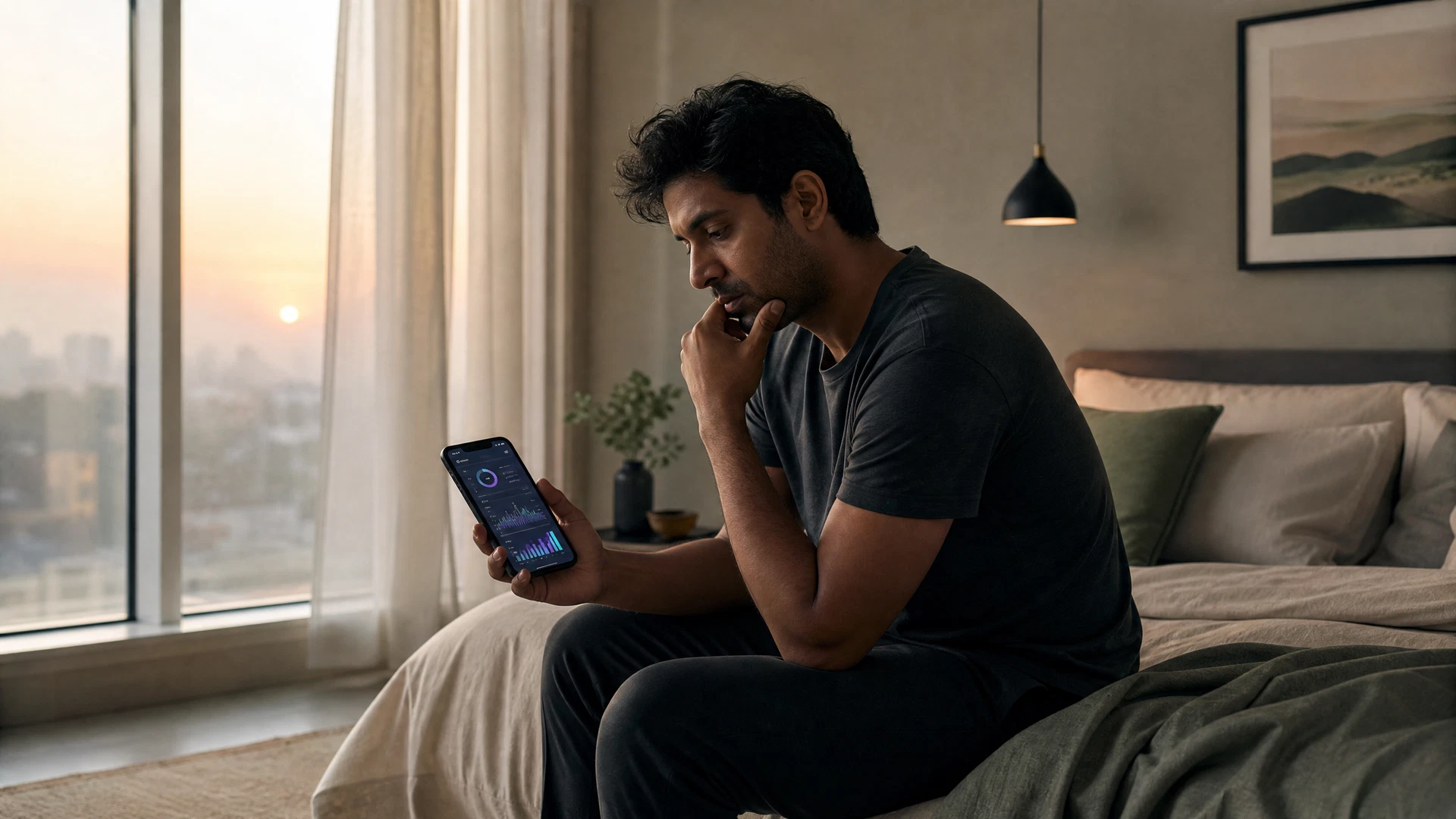
A precise-looking age can feel authoritative. Before treating a proprietary wellness score as insight, ask what it predicts, how it was validated, how uncertain it is, and what data you exchanged to receive it.
What Eight Sleep announced
Eight Sleep says its Biological Age feature combines nightly Pod signals with optional activity data and, for a U.S. beta group, medical records connected through HealthEx. The company says its model was trained on more than 100,000 participants and 2.7 million biometric hours, and that Biological Age and Speed of Aging update weekly.[1] These are company-reported development figures, not independent proof that the score predicts disease, longevity, or treatment response.
Six questions make the score more useful
| Question | Why it matters |
|---|---|
| What outcome was predicted? | A score can be trained to resemble age without predicting health events or lifespan |
| Was it independently validated? | Internal development data do not replace external replication |
| What is the error range? | A single number can hide uncertainty and normal day-to-day variation |
| Who was represented? | Performance can differ by age, sex, health, geography, and device use |
| Does a change alter a clear decision? | A trend is not useful if it only creates anxiety or repeated checking |
| What data are required? | The privacy cost changes when records, labs, medications, or linked-app data enter the model |
The company says it is not a medical device
The announcement states that the Pod is not a medical device and that Biological Age and Health Check are not intended to diagnose, treat, cure, or prevent disease.[1] That boundary matters. A wellness score should not replace a clinician, validated screening, or treatment decisions, and a week-to-week change should not be interpreted as proof that the body has literally aged faster or slower.
The input can extend beyond sleep
Eight Sleep’s privacy notice says the service can collect device signals, account and health information, linked Apple Health or Google Health Connect data, and clinical records authorized through platforms such as HealthEx.[2] The company says clinical-record access can include laboratory and diagnostic results, vital signs, medications, and allergies, and that these data may contribute to personalized insights and the Biological Age score.[2]
Consent is only the start of the privacy check
The current privacy notice says HealthEx access is consent-based, can be disconnected, and stored clinical health data are retained for up to one year, with automatic deletion when authorization expires or is revoked.[2] It also says pseudonymized health and sleep data may be used to improve health models when separate consent is provided.[2] The consumer-health-data policy describes rights that may include access, deletion, withdrawal of consent, and information about disclosure, depending on location.[3] Read the current policy in your jurisdiction before linking records.
Use the number as a prompt, not a verdict
If you choose to use a proprietary score, focus on transparent inputs you can verify—sleep timing, activity, or other measured behaviors—rather than chasing the age number itself. Look for stable trends, confirm unexpected readings with established methods, and disconnect data sources that are not worth the privacy trade-off. A score should support a clear decision, not create a new obligation to optimize every night.
The more exact the score appears, the more important it is to ask where the uncertainty went.
This is an independent consumer-literacy analysis, not a product review, endorsement, diagnosis, or privacy-law opinion. Product features and policies can change; consult the current company documents and qualified professionals for medical or legal questions.
Continue with the Wellness archive or browse all Fiteforms articles.
Sources and further reading
1. Eight Sleep Introduces Biological Age — Company press release dated 3 September 2026; claims and dataset figures are not independently validated here.
2. Eight Sleep Privacy Notice — Company privacy notice last updated 25 August 2026; describes linked records, consent, retention, and model-improvement uses.
3. Eight Sleep Consumer Health Data Privacy Policy — Company policy effective 25 August 2026; rights vary by applicable jurisdiction.